

How Agencies Manage Client Content Without Giving GitHub Access
See how agencies use Outstatic to give clients a real editing experience while keeping content in GitHub behind the scenes.
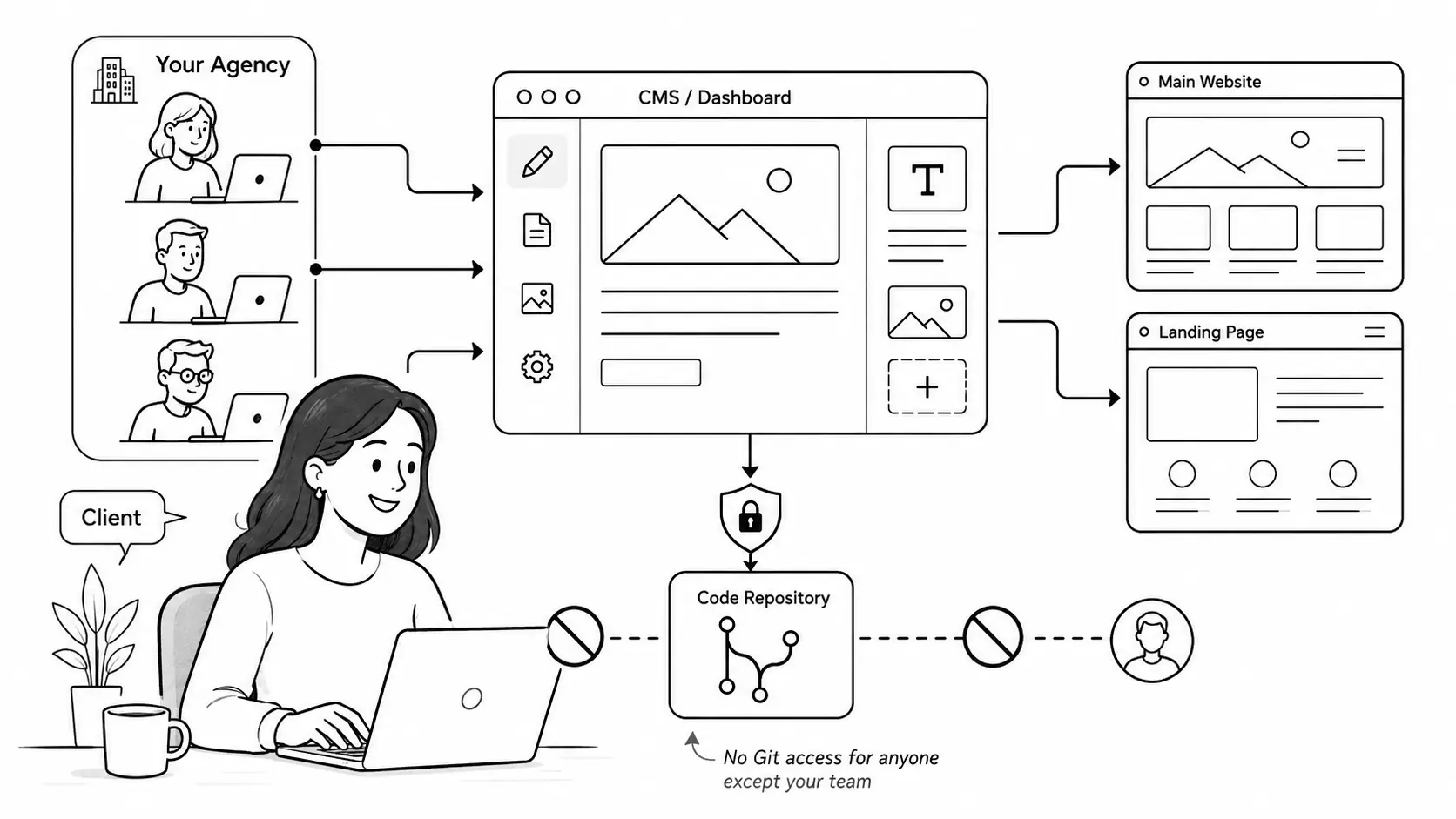
Agencies often want the same thing on every client project: a site that is easy for the client to update and easy for the agency to maintain. The hard part is getting both without turning the project into a fragile custom admin system.
GitHub is excellent for developers, but it is rarely the right interface for clients. Outstatic gives agencies a way to keep content in GitHub while giving clients a real CMS experience.
The usual agency pain points
Client content creates friction at every stage of a project. During buildout, copy changes arrive in docs, spreadsheets, emails, and chat threads. After launch, the client needs to update posts, landing pages, resources, team profiles, and announcements without filing a ticket for every small change.
The agency still needs control. The site should remain versioned, reviewable, and deployable. Content should not drift away from the repository. Developers should not need to rebuild core publishing workflows for every client.
Traditional CMS tools can solve the editing problem, but they often add a separate backend, API layer, hosting concern, and migration path. For many agency sites, that is more infrastructure than the project needs.
Why GitHub access is a blocker for clients
Giving a client direct GitHub access sounds simple until you think through the workflow. Clients need to understand branches, commits, pull requests, Markdown syntax, repository structure, and the consequences of editing the wrong file.
Even when a client is comfortable with technology, GitHub is not designed as a content editor. It lacks the guardrails, field labels, media workflows, and publishing language that non-technical users expect from a CMS.
There is also a permissions problem. Most agencies do not want every content editor to have repository access. They need a safer surface that limits users to the content they are allowed to manage.
How Outstatic solves approvals and editing
Outstatic acts as the editing layer on top of the repository. Clients can create and update content in a CMS dashboard, while the content is still saved as Markdown or MDX in GitHub behind the scenes.
That gives the agency a cleaner approval model. Content changes can be reviewed before deployment, tracked in Git history, and rolled back when needed. Editors work in a familiar interface, and developers keep the source of truth in the repository.
For agencies, this reduces the gap between handoff and maintainability. The client does not need to learn the codebase. The agency does not need to operate a separate content database for a straightforward marketing site.
Email, Google login, and role-based workflows
Client access becomes much easier when users can sign in with familiar identity providers. Outstatic PRO workflows can support client-friendly login patterns such as email or Google login, so content editors do not need GitHub accounts.
Role-based access helps keep responsibilities clear. A client editor may be able to draft and update content, while an agency admin controls broader configuration and publishing permissions.
That matters for long-term maintenance. The agency can give clients enough access to move quickly without giving them the keys to the repository.
Keeping Git as the source of truth
The most important part is that Git stays central. Outstatic does not force the agency to move content into a proprietary system just to give clients an editor.
Content remains file-based. Developers can inspect it locally, review it in pull requests, and deploy it through the same pipeline as the rest of the site. If the client ever moves platforms, the content is still in Markdown or MDX, not trapped in a database export.
This makes projects easier to hand off and easier to revisit months later.
Agency use cases and handoff model
Outstatic works well for agency-built marketing sites, blogs, resource libraries, documentation hubs, landing page collections, and portfolio sites.
The handoff model is simple. The agency builds the Next.js site and content schema. The client gets CMS access. Outstatic commits content changes to GitHub. The deployment platform rebuilds or revalidates the public site.
The result is a maintainable site with a client-friendly editing workflow and a developer-friendly source of truth.
Start an Outstatic PRO trial
If your agency wants clients to edit content without touching GitHub, Outstatic PRO gives you the workflow to do that while keeping the repository clean and maintainable.